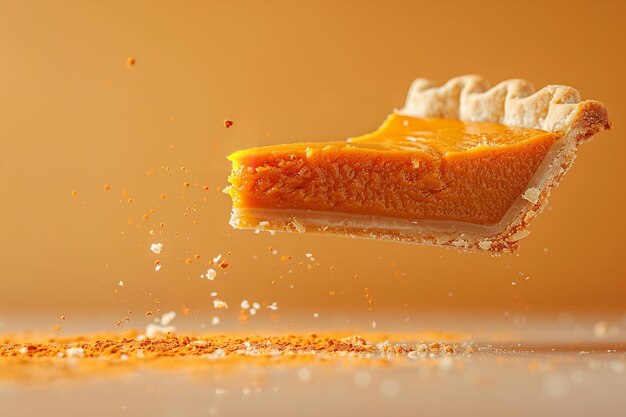
Do pumpkin pies float?
Last weekend, I had the privilege of journeying with the church’s middle and high-school youth to Mound Ridge in Saint James, MO for a weekend service retreat. On Saturday evening, they split into two teams and had a fierce trivia competition, and one of the questions was “does a pumpkin pie float?” From my initial Google analysis, I found, to my surprise, that pumpkin pies do float; and since you can trust everything you see on the internet, I felt confident it was a good trivia question. However, the youth were quick to inform me that it depends on various factors, and that the question “do pumpkin pies float” didn’t have a right or wrong answer. After a little more research I found out that the youth were right. From ingredients and preparation method, to cooking dish and time- there are several factors that dictate whether a pumpkin pie will float.
I enjoy a good game of trivia- there is something about a game with a definitive answer for each question that is satisfying. I think so many of us like trivia because even though we may not know all the answers, being able to know when something is right or wrong is comforting to us- it provides a sense of certainty. There isn’t much gray area when it comes to a good trivia question- you are either right, or you are wrong, there is a certain answer. And that’s what makes “Does a pumpkin pie float?” such a difficult trivia question- there is grey area, a room for uncertainty, the answer doesn’t meet our expectations.
The Bible has little to say about floating pastries, but there is truth to be found in the dichotomy between the levtionary readings from 2nd Samuel and the Gospel of John. The first reading from 2nd Samuel highlights David’s prophetic final words regarding GOD’s faithfulness to his lineage and to the people of Israel. David was anointed as King and his royal status was unquestioned- he is identified as “the anointed”- the messiah. During his life and reign, he was considered to be one sent by GOD to rule justly, liberate the people, and establish a secure kingdom for Israel. And in these, his final words, David identifies GOD’s faithfulness as providing order and security- certainty.
This stands in contrast to our gospel reading from John. Jesus, the Son of Man anointed by GOD as Messiah, in his final days stands before the Roman governor, Pilate, accused of blasphemy and sedition- facing death, questioned, as his life hangs in the balance. Jesus has been heralded by his disciples and the people of Jerusalem as king- yet his reign on earth has looked much different than that of his forefather David, or of any other king at that time. Pilate is correct in questioning Jesus’ royal status. This man Jesus, who stands before the Roman court, does not hold himself like a king. He is dressed as a commoner, he has no military prowess, he does not live in a lavish palace, and he regularly engages with outcasts, sinners, the sick, and the poor. His own people have even handed him over to be tried and put to death. There is a sense of uncertainty regarding Jesus’ royalty. Pilate demands that Jesus answer his pointed question- “Are you the King of the Jews?” For Pilate, this question holds no gray area, there is no room for uncertainty, it is either “yes” or “no”. You are either wrong or right. But it is not that easy. While Pilate demands certainty from Jesus- his response leaves room for uncertainty and ambiguity, and it is here where truth enters. Jesus responds to Pilate that his kingdom does not belong to this world- it doesn’t fit expectations, and it doesn’t provide the certainty that Pilate, and the world, so fervently demands.
Our world demands certainty- our culture demands certainty. Just like a good trivia question we want to know what is “right” and what is “wrong”. We want to know who is “us” and who is “them”. Our culture encourages us to identify ourselves and others by worldly titles and standards in pursuit of this certainty. Nationality, religious affiliation, political party, educational and income status- all examples of a culture that seeks to remove any ambiguity and solidify our identity in worldly certainty. There is little room for ambiguity or uncertainty in our culture today. The world seeks to claim us through these various identities- to keep us certain in ourselves and in our way of living while remaining distant from any uncertainty or ambiguity.
Christ’s reign is one of uncertainties and ambiguities. Christ came into a world that was certain- there was a certain expectation for a king like David: politically strong with a military mind, a king who would re-establish Israel as a great and mighty power- a king whose life and reign would bring about an era of certainty. Instead, Jesus came as a humble carpenter who travelled with a group of tax collectors and fisherman- healing the sick, feeding the hungry, and preaching love, forgiveness, and compassion. He taught in uncertain parables and fulfilled ambiguous prophecies. This is not the certain and expected king that the people were awaiting. Unlike King David, whose reign was unquestioned and whose life ended with a sense of peace and certainty for his lineage and for the kingdom, Jesus’ final days were spent before a Roman court- tortured, and crucified. His body was sealed in a tomb with a deep sense of uncertainty for the future. There is uncertainty among his disciples about his rising and there is uncertainty about how and when Christ will return. Pilate demands certainty- the person and reign of Christ leaves room for uncertainty.
While the world demands certainty, GOD’s truth can be found amid the uncertainty.
The story of David and the story of Jesus have completely different endings, and yet they somehow point to the same faithful GOD. While the world demands certainty, GOD’s truth can be found amid the uncertainty and ambiguity- in the space in between that occupies the yes and the no. GOD does not act in a unilateral and certain way – “like the sun rising on a cloudless morning, gleaming from the rain on a grassy land” (2 Samuel 23:4). Our worldly ideas for the reign of Christ, rooted in GOD’s truth, should be tested against scripture and against the life of Jesus Christ. The reign of Christ is happening at this very moment, and it is present in our midst. Many of the people of Jesus’ time overlooked it, Pilate overlooked it, Jesus’ own followers overlooked it, and if we get so caught up in our own certainties, our worldview, our ideas of how things ought to be, allowing the world to claim us and identify us with worldly certainty, we run the risk of overlooking it as well.
The reign of Christ is manifest in women reassuring one another amid the uncertainty of a cancer diagnosis, it is visible in a community of comforting one another after the loss of a loved one, it is present in the faint hope of those uncertain of the path forward but who are willing to step out in faith and determination. The reign of GOD does not insist on power or prestige, and it does not rely on worldly certainties. It shows up in the gray space, in the unknown, in the uncertainty, and finds ways to surprise us with grace. So too is our call- we are part of this reign of Christ that is happening now. We are called to be the hands of feet of this kingdom- to be the ones who live out our hope in uncertainty, because we know that even in this, GOD is still present and at work. We can rejoice in the uncertainty because we know that GOD can do very certain things with very uncertain circumstances.
We can rejoice in the uncertainty because we know that GOD can do very certain things with very uncertain circumstances.
We are not claimed by the certainties of the world, but by GOD. The reign of Christ brings about uncertainties that may challenge our worldview, but when we live into this uncertainty and bear witness to GOD in the uncertainty, we can find our faith flourishing in unexpected ways. The reign of Christ is present- it is here- it is active and ongoing- it is in this world, yet it is not of or defined by this world. The reign of Christ- the reign of truth- occurs amid the uncertainty, it occupies the gray space between our expectations and GOD’s unending faithfulness. We are called to shed the certainties of the world to adopt the joy of faith in Christ- a faith that brings peace which surpasses any challenge we may face. The world expects this Reign of Christ to show up in a certain way, according to its expectations. We have a responsibility to show the world that this Reign of Christ is present now- is happening now- and that it does not conform to the certainties of this world because it is not defined by this world. It is uncertain, it is ambiguous, and it is a Reign which opens floodgates of faith to bring an unexpected love, compassion, and grace to a world that is so certain.
And so, I ask again: does a pumpkin pie float? You know- I’m not certain. There is a grey area. It’s ambiguous. The answer is somewhere in between. And thanks be to GOD for that.
Scripture Passages: 2 Samuel 23:1-7, John 18:33-37
Preached at Webster Groves Presbyterian Church (St. Louis, MO) on Sunday, November 24th, 2024 [Reign of Christ Sunday]




 The TASK
Leave a comment