One right turn was enough to send everything awry…
During my first summer as a Boy Scout, my troop went on a hiking trip to the National Military Park in Shiloh, Tennessee. Our goal was to complete a 14-mile hike through the park in an effort to complete the hiking merit badge. It was a great opportunity; not only would we get hiking experience, but we would also have the opportunity to develop important navigational skills as well. We set up camp at a nearby Civil War battlefield campsite, and around 6 AM on our first full day, we set out on our hike. One of the scout leaders had diligently mapped out the planned course and began leading the group of almost 60 excitable young boys and history buff dads along the trail. I remember hiking along for quite some time with my friends, joking, laughing, and enjoying ourselves despite the oppressive July sun beating down on us. It was sometime just before noon when we came to a spot where the path forked off into four different directions, and our leader told us that this was the halfway point and the place we would be stopping for a quick but much needed rest and lunch. After we ate, we followed the trail to the right which would take us through the center of the park and return us to the original path that led back to our campsite. But one right turn was enough to send everything awry.
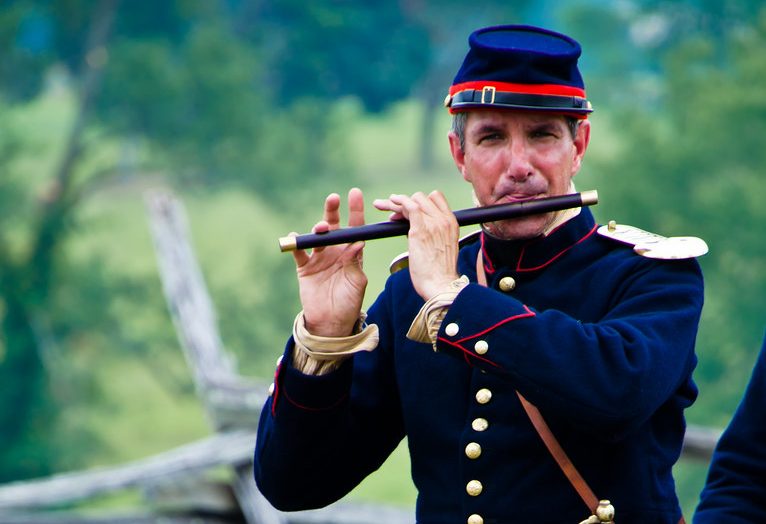
I never fully understood the role of the fife when it came to the battle. Countless pictures and paintings show the fife being used by military personnel on and off the battlefield- perhaps the most famous example being Archibald M. Willard’s “Spirit of ‘76” painting. In fact, we saw a number of paintings of wartime fifers during our time at the military park, and we even saw an exhibit that housed a worn fife recovered from the battle-worn fields of Shiloh. But it always seemed to me to be such a ridiculous role- particularly during the Civil War. Cannonballs and musket rounds fly by as tens of thousands are wounded or killed- how unlucky it must have felt to be stuck on the battlefield with nothing but a fife as the sole means of self-preservation. But to my surprise, the military band, including the fifes, had a much more important role than it may initially seem. First, they helped keep morale up during the difficult and gruesome conditions of battle. Second, they help soldiers identify when and where they were to move- a form of musical follow the leader. And third, the military instruments, particularly the fife, served as an important tool for generals and commanders in sending orders and conveying messages amid the chaos of battle. Military instrumentation was a crucial form of military communication in an age without modern technology; this was especially important in situations when your army must go in a certain direction, when one wrong turn is enough to send everything awry.
The prophet Jeremiah and the apostle Paul both write into contexts which have taken a turn towards chaos. During his early days, Jeremiah prophecies the imminent fall of Israel to the Babylonian empire as a consequence of the nation’s flagrant turning away from the will and wisdom of God. He ends up living through the turmoil proclaimed in his own words, but even in the chaos and uncertainty following Israel’s captivity to Babylon, he proclaims that God is faithful to Israel and will rescue the people in the coming days. The apostle Paul writes to a church in Corinth that has become overwhelmed with rivalry, jealousy, bitterness, and dissension towards one another over various theological, social, political views. What was once a thriving church in Corinth has become a hostile community which threatens to implode the reputation and unity of Christ, splattering it out like the islands of Greece. And while the Apostle Paul writes his letter to the Corinthians roughly 700 years after the preachings and prophecies of Jeremiah- both emphasize the fundamental importance of God’s love in our lives together. Both the prophet Jeremiah and the apostle Paul stand on the battlefields of their time with what may seem like a simple fife; but in reality, they are the ones who insist on the guidance and the instruction of God’s love. They may stand between two warring factions or in the crosshairs of uncertainty and chaos, but they have found their role in playing the marching orders and signals for God’s love. They stand as a guidepost along the pilgrim journey hoping to point in the true direction, even after a wrong turn has sent everything awry.
It wasn’t until we got to the Texas State Monument that we scouts began to suspect something may not be quite right. The large huddle of adults around the map, the disconcerted looks, not to mention the wide open field that seemed to never end, were some of the first signs that something wasn’t exactly going to plan. It was around 5 PM as we rested near the slim stone monument, when our leader told us the news: we had made a wrong turn. In keeping down that path, we were now eight miles away from our start location, we went right when we should have gone left. What had been planned as a 14-mile hike ended up becoming a 22-mile hike. The hot-July sun was brutal, and many of the scouts had run out of water as the day had gone on. As the sun was making its way towards the western horizon and the katydids began their evening hum, we realized where we had arrived- we were in the middle of the field where the primary battle of Shiloh took place. There are parts of that hiking trip that I don’t remember, and there are certainly parts I have tried my best to forget, but what will forever stick out in my mind is the overwhelming and absolutely deafening silence of that field in the southwestern corner of Tennessee. All around there were seedling trees being planted as part of an ongoing effort by the US Government to cultivate any kind of native growth in the area- but the struggling trees only stood as a sign that no matter how hard we tried to cover up the scars, pain, and horror of war, the land remembers- and in that field nothing takes root and grows. In that silence, you could hear the echoes, like clanging symbols and noisy gongs, of what happens when we forsake love and compassion for one another. I remember the historian mentioning how many of those fighting were siblings, grew up together, left the same homes to fight on these fields. It may not necessarily have been the growing of hate, but it most certainly was the losing of love which caused such a national tragedy. One wrong turn can send everything awry.
It may not necessarily have been the growing of hate, but it most certainly was the loss of love which caused such a national tragedy…
I have returned to that field over the past few weeks. There has been a growing loss of patience with one another in our national discourse and cultural sentiment. Our culture seemingly no longer values reasonable dialogue and thoughtful compromise, but upholds the power of a good burn or diss. Mass deportations have begun across the nation, and the fate of thousands of immigrant families hangs in the balance as part of this cultural and political war of attrition. Disagreements over things like LGBTQ rights, immigration, economic policy, DEI, foreign aid, and how we plan to keep air traffic controllers healthy and well while they do the important work of keeping us safe have overwhelmed our news cycle, and at times threatened to tear at the fabric of the church at large, and maybe for some of you, it may feel as though it is tearing at your church family. No matter what political party or agenda you align with- it is difficult to deny that we are living in a time that feels very chaotic and uncertain, and for many, this uncertainty causes tensions and anxieties to run high. It feels like no matter which way we turn, we aren’t really on the right path- it feels like we have hiked all the way out to the edge of the park, we are looking at the field where nothing has or will grow, and we have a long, long, way to get back to where we started. It feels as though the journey back is going to be difficult, no matter who has the map. We have been on the wrong path for quite some time, but one right turn is enough to send everything awry.
That field was sobering- it was a reminder of what is at stake when we lose love for one another. It was the furthest point from hope along that pilgrim journey. It was a stark reminder of what can come when we fail to see humanity within the other. When we fail to have patience, kindness, gentleness, humility- love. That field was a sobering place, but sometimes I look back and see the importance of a wrong turn- that it can be enough to send everything awry.
Play the fife that guides and instructs, not in the way of some battle-driven commander or chief, but in a still more perfect way, in the way of God’s eternal reign rooted in love.
When it does go awry, when we find ourselves looking out into that field, or caught up in the crosshairs of the battles of the world today, what is our role? Where are we supposed to find ourselves? Because, I must admit, it can be tempting to engage directly in battle, especially when the chaos is happening all around us- at some point, it becomes less about what we believe and more about self preservation, right? My friends, against all our natural instincts, we have a call to stand in the crossfire and boldly play the fife. To play the fife that guides and instructs, not in the way of some battle-driven commander or general, but in a still more perfect way, in the way of God’s eternal reign rooted in love. To play the fife that signals the directions, instruction, wisdom, and guidance of love. But there is some unfortunate news about this call: I cannot guarantee to you that you are going to be safe. I cannot promise that you will not get caught up in the crossfire of the battle. I cannot promise that this fife will always be heard by those around you- sometimes the battle is going to overwhelm the sound of your singular fife. In those moments, in those moments when you have made your way to the very edge of the park, when you are staring out into the wounded field, when all you have is your single fife and the orders to play through it, while chaos is swarming around you- play. Play. Play and do not stop playing. Play on this battlefield that is our current culture and climate- this culture that has turned so far from God’s love. In playing you carry out your call, your mission, to which God has ordained you, to proclaim what God’s love has in store: how it is guiding, shaping, teaching, encouraging, sustaining, nurturing, binding together, so that nothing can separate us, not even the scars and wounds of battle- we belong to each other, and it is because of God’s love that we are claimed into this one family. So play your fife, be a guide along the pilgrim journey, because some of those near you may follow your lead and will make the right turn- and it only takes one right turn to send everything awry.
In playing you carry out your call, your mission, to which God has ordained you, to proclaim what God’s love has in store: how it is guiding, shaping, teaching, encouraging, sustaining, nurturing, binding together, so that nothing can separate us, not even the scars and wounds of battle.
We ended our hike around 9 PM- just as the sun was beginning to fully set. We spent the next few days in Shiloh touring Civil War museums and tending to our worn out and tired legs. One of the places we toured was an underground tavern where Civil War Union musicians and soldiers would gather to listen to music, eat, drink, and hope for better days- where they would gather in song, prayer, and fellowship. Perhaps one might call it a type of church. That trip to Shiloh was one of my first scouting trips, and my memory about it is somewhat hazy, but I do remember, as I look back to standing in that still and somber battlefield, hearing the faint whistle of a fife, maybe perhaps from ages past. As I stand in that field way, it whispers that love is the true guide along this pilgrim journey.
Originally preached at Webster Groves Presbyterian Church on Sunday, February 2nd, 2025.
Scriptures: Jeremiah 1:4-10 and 1 Corinthians 13:1-13






 The TASK
Leave a comment